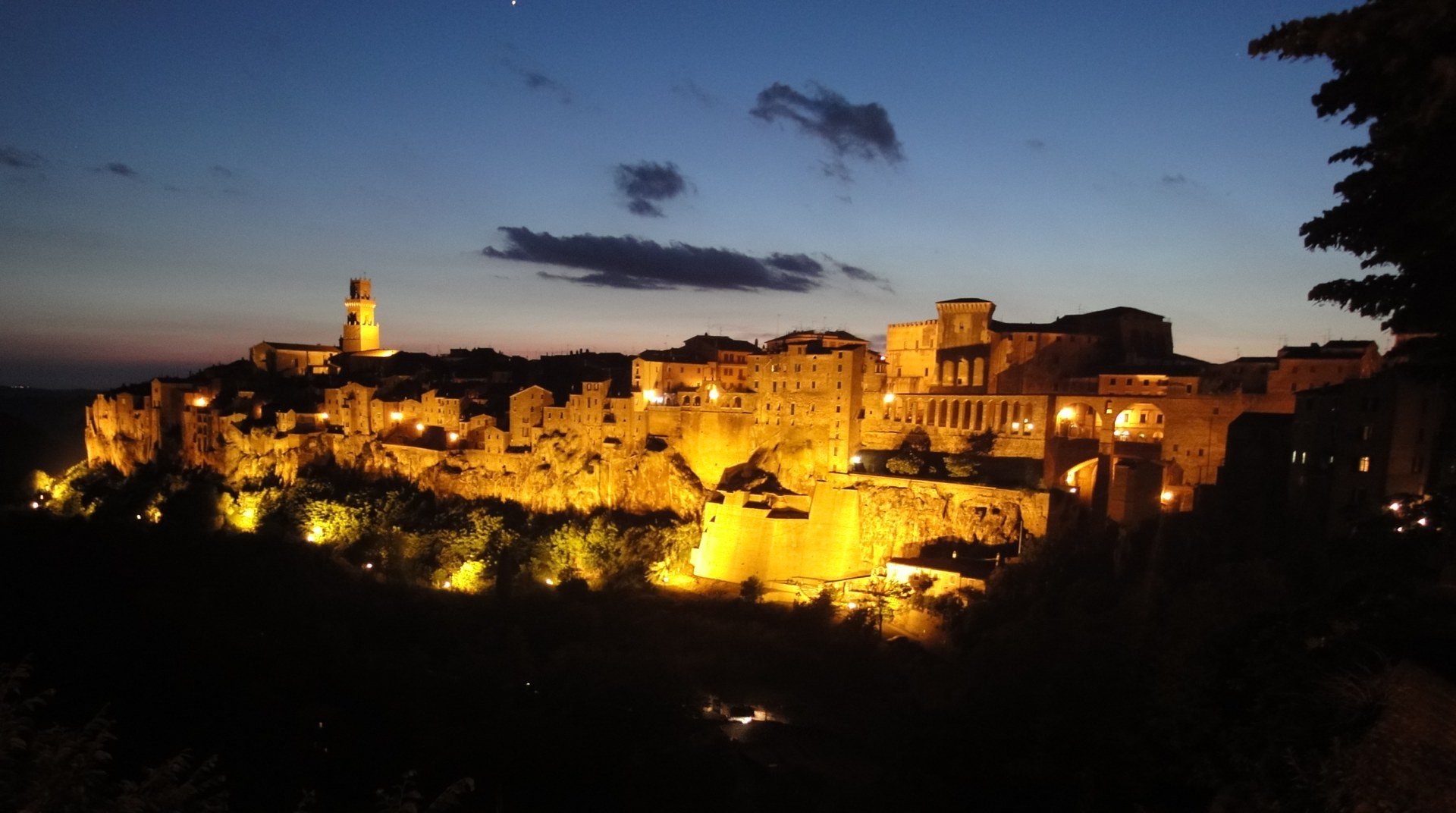
Pitigliano

Pitigliano is so beautiful, so enchanting, that it’s surprising how little tourist attention it receives.

It is without a doubt the Maremma’s greatest treasure and most breathtaking city.

You will not see anything like it anywhere else in the world, and the locals who don’t live in Pitigliano have begrudging accepted that it is, without a doubt, their most beautiful offering to international tourists.

Past the city walls, Pitigliano is a breathtaking maze of cobbled streets and alleys, worn but quaint houses and tiny bursts of lush green patio gardens.

Here the people are experts in their local history and rich heritage. Cultured, with a city-air about them, the Pitiglianese are viciously proud of their home and desperate to tell anyone who will listen about its roots.

And so they should. Pitigliano can trace its roots back 3500 years.

According to local legend, two young friends, thieves who had stolen the golden crown of Giove Statore (otherwise known as Zeus), fled from Rome and settled in the Fiora Valley.

Inspired by the beauty around them, they decided to build a kindgom and called it Petiliano, an amalgamation of their names Petilia and Celiano, bringing nearby residents together with promises of wealth and prosperity.

Legends aside, Pitigliano was already home to a grand civilisation long before Petilia and Celiano came to call. Ruins in the area date back to the Etruscans, who flocked to the countryside because of its cool climate and abundent water supply.

Like most of the Maremma, the city of Pitigliano is distinctly medieval, shaped into its current form by the powerful Aldobrandeschi family.

However, the city has one element that elevates it far above the rest. Pitigliano is carved entire into the tufo rock cliff it sits on.

During the day, the way in which the beautiful stone houses wrap themselves around the harsh rock below is breathtaking, but during the night, the effect is nothing less than enchanting.

It’s as if the buildings are the leaves of an old and gnarled tree. There are so intertwined with the cliff, that you can’t tell where one ends and the other begins. The sight will take your breath away.

The city is also home to Tuscany’s only Jewish Ghetto, built to house fleeing Italian Jews in the 1500s.

Allowed complete cultural and religious freedom, this community flourished, earning Pitigliano the nickname “Piccola Gerusalemme” – Little Jerusalem.

Today you can still walk through the Jewish Ghetto, which is eerily empty and remains unchanged from the years when it was filled with life and colour.

SIGHTS:

Cattedrale degli Santi Pietro ed Paolo
This medieval cathedral restored by the Orsini Counts to reflect their somewhat garish taste is one of the Maremma’s most important cathedrals.
Chiesa di San Rocco
Also known as the Church of Santa Maria, this church is Pitigliano’s oldest and most venerable religious building.
Santuario della Madonna delle Grazie
This shrine was built as a simple rural chapel in the early 15th century, but was transformed into a beautiful monastery with a gorgeous garden.
Acquedotto Mediceo
This aqueduct might not be Roman, but it is Pitigliano’s most alluring architectural feature, located in a piazza with the best city views.
Oratorio Rupestre
Located in an incredibly wild garden, this ‘rock’ is one of the oldest symbols of civilisation remaining in all of Italy.
Palazzo Orsini
The official residence of the lords of Pitigliano, the Orsini family. Despite its illustrious name, the castle was originally built for the Aldobrandeschi.
Monumento alla Progenie Ursinea
Sitting at the feet of the Palazzo Orsini, this traventine statue was built in the 1500s as a wedding gift for one of the sons of the Orsini Counts.
Poggio Buco
Located about 9km from Pitigliano on the road to Manciano, there are few reminders of Maremma’s Etruscan past like this necropolis.

MUSEUMS:

Museo del Palazzo Orsini
This large museum displays the most magnificent and priceless religious artifacts and works collected from churches all over the Pitigliano diocese.
Museo Civico Archeologico della Civiltà Etrusca
This museum reconstructs the Etruscan life from various artifacts and archaeological objects found in the nearby Poggio Buco necropolis.
Museo Archeologico all’aperto Alberto Manzi
Also known as the “City of Life, City of Dead” Outdoor Archaeological Museum, this museum is another chance to wander through an ancient Etruscan city.

JEWISH GHETTO:

The Ghetto
In the 1500s, Pitigliano became a refuge for Italian Jews escaping the harsh Papal Notes that severely restricted their life and economic activity.
Sinagoga
Built in 1598, the Synagogue is at the heart of the Jewish Ghetto.  It was damaged in WWII, but carefully rebuilt.
Museo della cultura Ebraica
This museum displays many of the testimonies and treasures donated by members of Pitigliano’s past Jewish community.
La Macelleria Kasher
The Kosher Butcher, this building  is carved completely out of the tufo rock and almost looks like a little cave.
Bagni Milkve
A special public bath, also carved out of the rock and used by the Jewish community to purify themselves during religious festivals.
Forno delle Azzime
Beautifully preserved, this bakery is protected by a the gate, which is crowned by a menorah, the seven branched candelabra used by the Jewish.
Cantina
For decades, this beautiful cellar was buried under rubbish and completely cut off from view. Luckily it’s now been restored and is open to tourists.
Il Cimitero Ebraico
This Jewish cemetery tells the sad story of Jewish doctor Davide De Pomis and the death of his young wife.

EVENTS:

Torciata di San Giuseppe- March
A deeply felt festival whose central ritual, the burning of a wooden pyre, dates back all the way to the Etruscans.


Copyright © 2010 | Maremma Tuscany | Tutti i diritti riservati
By Web Maremma Via Brigate Partigiane 6 - 58014 - Manciano (GR) - CF dttgli29l81e875s - P.IVA 01371370535